
A man came in last month with every symptom of low testosterone and a total testosterone squarely in range. His previous doctor had told him he was fine. He was not fine. His SHBG was high and his free testosterone was on the floor. I see this often enough that I recorded an entire podcast episode on it, and it is this month's clinical section below.
One pearl from that episode. There is early evidence that boron may lower SHBG and raise free testosterone. More in the podcast. 😊
The short version: the number is not the diagnosis. The patient is. If you take one thing from this issue, take that.
Yousef Elyaman, MD, IFMCP
In This Edition
- This Month in the Mastermind: A welcome to our newest members, September's live sessions, and the topic you voted on for October.
- What's New at FMP Essentials: The public podcast, two conference talks this fall, a member discount for IMMH, and meetups at both events.
- Clinical Perspective: Why a "normal" total testosterone may not rule out clinically relevant testosterone deficiency.
- Mastermind Podcast Spotlight: Dr. Elyaman on low testosterone in men: evaluation, metabolic drivers, and treatment considerations.
- Blog Feature: Low testosterone as a metabolic warning sign, not just a hormone problem.
This Month in the Mastermind
Welcome to our newest members. Fourteen clinicians joined the Mastermind this summer, and three members moved up to Gold. If you are new, you are in the room now. If you have been here since the beginning, these are your new colleagues. Say hello when you see a new name in the community.
September live sessions. Because the first Monday was Labor Day, the Silver deep dive moves to the third Monday this month.
- Gold Leadership and Success, Monday, September 14, 5:30 PM Eastern: Beyond the Bottle, Part 2. Turning the supplement framework from Part 1 into an actual program in your practice.
- Silver Clinical Deep Dive, Monday, September 21, 5:30 PM Eastern: The hidden iron overload case nobody catches. Bring the patient it reminds you of.
Bronze members: Gold and Silver open again in January. Put your name first in line at fmpessentials.com/mastermind and you hear 48 hours before anyone else.
You chose October. The Gold members voted on the next leadership training, and the answer was clear: how to price your services. That session is being built from your own words.
Share a win. A case you caught, a decision you finally made, a Monday that went better than the last one. Big or small, it counts, and it helps the rest of the room see what is possible. Put it here and help us celebrate.
What's New at FMP Essentials?
- Public Podcast: This month's public podcast features Dr. Lara Zakaria discussing how wearable technology can reveal meaningful patterns in metabolism, glucose regulation, stress, sleep, and recovery, and where the data may be misleading. Available now on YouTube, Apple Podcasts, and Spotify. Click here to watch now.
- IMMH Conference, and a member discount: Dr. Elyaman will be speaking at the Integrative Medicine for Mental Health Conference, October 8 to 11 at the Town and Country Resort in San Diego. His session, Getting to the Root Cause of Suicidal Ideation: An Integrative and Functional Medicine Perspective, explores suicidal ideation as a biological distress signal and what to evaluate and treat alongside conventional care. The lineup includes Robert Lustig, Jill Carnahan, Bessel van der Kolk, Dale Bredesen, James Greenblatt, Nasha Winters, and more than fifty others, with up to 40 CE and CME credits and 90 days of recording access included. As a speaker, Dr. Elyaman can pass along a discount: save $100 on in-person tickets with code ABSOLUTEHEALTH100, or $50 on virtual with code ABSOLUTEHEALTH50. Register here.
- ILADS Annual Scientific Conference: Dr. Elyaman will speak at the 2026 ILADS Annual Scientific Conference, October 22 to 25 in Herndon, Virginia. His presentation will explore a systems-based diagnostic approach to cognitive decline and complex chronic disease. Click here to learn more and register.
- Meetups at both conferences: We are planning a member meetup at IMMH and at ILADS. If you are going to either one, reply to this email and tell us which, and we will send you a WhatsApp link so we can stay connected during the event and find each other between sessions.
Clinical Perspective: Could a "Normal" Total Testosterone Level Miss Low Testosterone?
A man presents with fatigue, reduced libido, changes in mood, and difficulty maintaining muscle mass, but his total testosterone is within the laboratory reference range. Does that rule out testosterone deficiency?
In a recent episode of the FMP Essentials Show, Dr. Yousef Elyaman explains why total testosterone is only one part of the picture. Symptoms, testing conditions, sex hormone-binding globulin (SHBG), free testosterone, and the broader hormonal pattern can all affect interpretation.
4 Things to Think About Clinically
1. A total testosterone result is not the diagnosis
Symptoms such as reduced libido, erectile dysfunction, fatigue, low mood, and unfavorable changes in body composition are nonspecific, but they provide essential clinical context. Current guidelines recommend diagnosing hypogonadism only when compatible symptoms or signs occur alongside consistently low testosterone concentrations.
2. Timing and repeat testing matter
Testosterone varies throughout the day and between days and may be temporarily suppressed by food intake, acute illness, certain medications, or inadequate sleep. The Endocrine Society recommends measuring fasting total testosterone on two separate mornings before confirming a low result.
3. SHBG can make total testosterone misleading
Most circulating testosterone is bound to SHBG or albumin, while only a small proportion circulates freely. Elevated SHBG can produce a reassuring total testosterone result even when free testosterone is low. Conversely, low SHBG, commonly associated with obesity and type 2 diabetes, may lower total testosterone while free testosterone remains adequate.
When total testosterone is borderline or a condition affecting SHBG is present, guidelines recommend measuring free testosterone by equilibrium dialysis or calculating it using total testosterone, SHBG, and albumin. Direct analog free testosterone immunoassays are not recommended because of concerns about accuracy.
4. Confirmed deficiency should prompt a search for the cause
LH and FSH can help distinguish primary testicular dysfunction from secondary hypothalamic or pituitary causes. Depending on the presentation, further evaluation may include prolactin, iron studies, estradiol, thyroid function, metabolic markers, medication review, and assessment for conditions such as obesity, insulin resistance, or sleep apnea.
What Does the Research Show?
In the European Male Ageing Study of 3,334 men ages 40 to 79, participants with normal total testosterone but low calculated free testosterone reported more sexual and physical symptoms than men whose total and free testosterone were both normal. In contrast, men with low total testosterone but normal free testosterone did not show the same pattern of androgen-deficiency symptoms.
The Endocrine Society also notes that approximately 30% of men with an initial testosterone result in the hypogonadal range have a normal result when testing is repeated. This reinforces why one isolated value should not determine the diagnosis or lead directly to treatment.
Clinical Takeaway
A "normal" total testosterone result does not always exclude clinically relevant testosterone deficiency, just as one low result does not confirm it. Interpret testosterone alongside symptoms, repeat fasting morning measurements, SHBG, and free testosterone when indicated. If deficiency is confirmed, look beyond replacement alone and investigate why testosterone is low.
References
- Bhasin S, Brito JP, Cunningham GR, et al. Testosterone Therapy in Men With Hypogonadism: An Endocrine Society Clinical Practice Guideline. J Clin Endocrinol Metab. 2018;103(5):1715-1744. doi:10.1210/jc.2018-00229
- Antonio L, Wu FCW, O'Neill TW, et al. Low Free Testosterone Is Associated With Hypogonadal Signs and Symptoms in Men With Normal Total Testosterone. J Clin Endocrinol Metab. 2016;101(7):2647-2657. PMID 26909800
- Naghii MR, Mofid M, Asgari AR, Hedayati M, Daneshpour MS. Comparative effects of daily and weekly boron supplementation on plasma steroid hormones and proinflammatory cytokines. J Trace Elem Med Biol. 2011;25(1):54-58. PMID 21129941
Check Out This Month's Podcast Episode
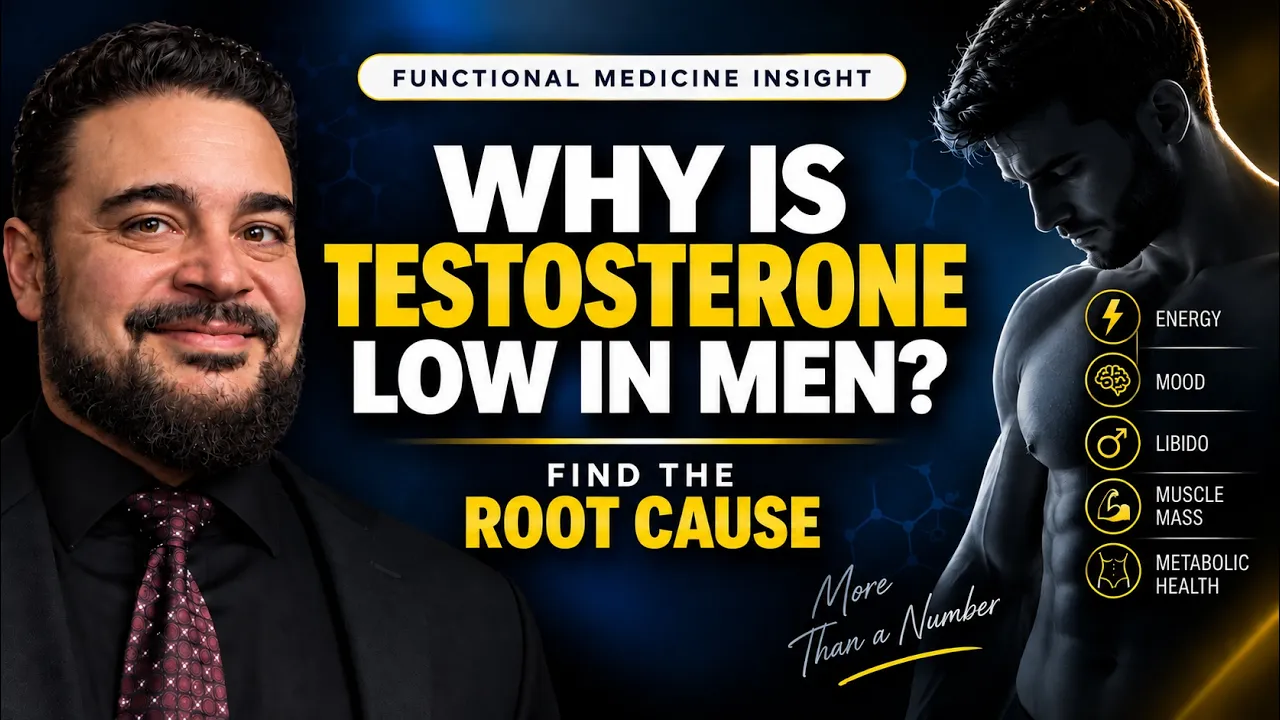
🎧 New Podcast Episode: Low Testosterone in Men: Looking Beyond the Number
In this month's episode of the FMP Essentials Show, Dr. Yousef Elyaman takes a functional medicine approach to evaluating low testosterone in men and explains why a single total testosterone result does not tell the full story.
He explores the symptoms, laboratory patterns, and underlying imbalances practitioners should consider before recommending testosterone replacement. He also discusses how insulin resistance, inflammation, sleep apnea, gut health, and environmental exposures may affect testosterone levels and long-term health.
Here is what he covers:
- Why symptoms matter alongside laboratory results
- Why total testosterone alone may be misleading
- How sex hormone-binding globulin (SHBG) affects free and bioavailable testosterone
- The roles of LH, FSH, estradiol, and estrone in the evaluation
- How insulin resistance and inflammation may contribute to low testosterone
- When low testosterone may signal sleep apnea or metabolic dysfunction
- What to consider before and during testosterone replacement
- Why addressing the underlying drivers remains essential for long-term health
This episode gives functional medicine practitioners a more complete framework for evaluating low testosterone, identifying potential root causes, and determining when replacement may or may not be appropriate.
How to watch or listen: Log into your account, select the Bronze Mastermind, and scroll down to the "Expert Interviews, Insights & Podcasts" section to find the episode.
Check Out This Month's Blog Post
Low Testosterone May Be a Metabolic Warning Sign, Not Just a Hormone Problem
This month's blog explores how low testosterone may provide clues about underlying metabolic dysfunction rather than representing an isolated hormone problem.
It also examines the connections among testosterone, insulin resistance, body composition, sleep apnea, and inflammation, and why testosterone replacement may be only one part of a broader treatment plan.
Click here to view the article.
A Final Thought
We know you have options. There are a lot of places a clinician can spend a Monday evening, a subscription, and a few hours of attention. You chose to spend some of yours here, and everyone at FMP Essentials is touched by that. It is not lost on us.
If you know a clinician who would fit in this room, send them here: https://www.fmpessentials.com/mastermind
They can join Bronze today, and put their name first in line for Gold and Silver. Enrollment opens again in January.
Thank you for being part of this.
The FMP Essentials Team



Responses