
In This Edition:
- What’s New at FMP Essentials: Stay updated on upcoming courses, practitioner meet-ups, exciting announcements, and new educational content.
-
- Private Mastermind Podcast Spotlight: This month’s episode features Dr. Melody Hartzler in a conversation on polycystic ovary syndrome (PCOS), now renamed PMOS, and what this shift means clinically. Dr. Elyaman and Dr. Hartzler explore endocrine-metabolic drivers, androgen symptoms, cycle irregularity, insulin resistance, and root-cause clinical considerations for practitioners.
- Blog Feature: This month’s blog explores the shift from PCOS to PMOS and why it matters clinically. We look at how PMOS reflects a broader endocrine-metabolic condition and what practitioners should know.
- Stay informed, engaged, and ahead of the curve with this month’s updates!
What's New At FMP Essentials?
- Public Podcast: This month’s public podcast features Everest Goldstein, a functional psychiatric nurse practitioner specializing in anxiety, nervous system regulation, and root cause mental health care. In this episode of the FMP Essentials Show, Dr. Elyaman and Everest explore how anxiety is not always just a mental health issue, but can also be a signal of underlying physiological imbalances. They discuss how blood sugar instability, cortisol dysregulation, nutrient deficiencies, gut dysfunction, mold exposure, chronic stress, and nervous system imbalance can all contribute to anxiety symptoms. Available now on YouTube, Apple Podcasts, and Spotify. Click here to watch now.
- IFM AIC Recap: Dr. Elyaman had a great time at IFM’s Annual International Conference in San Diego this May! It was a wonderful opportunity to connect in person with so many members and friends from the FMP Essentials community, present for the College of Functional and Integrative Physicians, listen to insightful talks, and spend time learning alongside colleagues in the functional medicine space. Thank you to everyone who joined the WhatsApp group, attended the conference, or stopped by to connect. We’re grateful for this growing community and always love the chance to bring these conversations beyond the screen.
- IFM Hormone Module Update: Dr. Elyaman is currently in Federal Way, Washington recording for IFM’s hormone module and is excited to be joining as a new educator for the men’s health portion of the module.
Clinical Insight: Is Polyendocrine Metabolic Ovarian Syndrome (PMOS) Hiding in the Glucose Rollercoaster?
PMOS, formerly known as PCOS, is often approached through a reproductive lens. But in this month’s early release podcast, Dr. Melody Hartzler highlights a clinically important metabolic pattern: standard glucose markers may appear normal while compensatory insulin resistance is already influencing ovarian signaling, androgen expression, and cycle function.
This is especially relevant for patients whose fasting glucose and hemoglobin A1c look reassuring, yet their symptoms suggest deeper metabolic dysfunction.
5 things to think about clinically
1. Hemoglobin A1c may obscure glycemic variability
Because hemoglobin A1c reflects an average, it may miss postprandial elevations followed by glucose drops. A patient can have “normal” average glucose while still experiencing clinically meaningful glucose variability.
2. Postprandial response may be more revealing than fasting glucose alone
Dr. Hartzler discusses using a continuous glucose monitor (CGM) or a carbohydrate challenge to assess how the patient responds after a carb load. This may help identify post-meal glucose elevations that are not apparent on fasting labs.
3. Reactive lows may be part of the pattern
As insulin rises to compensate, some patients may overshoot and experience low glucose after meals. Clinically, this may show up as afternoon fatigue or feeling worse after higher-carbohydrate meals.
4. Insulin can connect the inflammatory, metabolic, and androgen picture
Dr. Elyaman notes that insulin resistance may be driven by inflammation, excess sugar intake, and other upstream factors. As insulin levels rise to compensate, elevated insulin may stimulate ovarian androgen production, helping explain why metabolic dysfunction can show up as acne, hirsutism, irregular cycles, anovulation, or fertility challenges. Dr. Hartzler also highlights high-sensitivity C-reactive protein (hs-CRP) as a marker that may help contextualize the broader cardiometabolic and inflammatory picture.
5. Body size does not rule out insulin resistance
Dr. Hartzler notes that insulin resistance is often associated with weight, but some patients with PMOS may be lean and still have abnormal insulin or glucose patterns. Weight can be one clue, but it should not be used as the sole screen for metabolic risk.
Clinical takeaway
For patients with suspected PMOS, irregular cycles, androgen-related symptoms, or post-meal fatigue, normal fasting glucose and hemoglobin A1c should not necessarily end the metabolic assessment. Consider whether CGM patterns, postprandial glucose response, reactive lows, and compensatory insulin resistance may be revealing a deeper endocrine-metabolic driver.
Check Out This Month's Podcast Episode
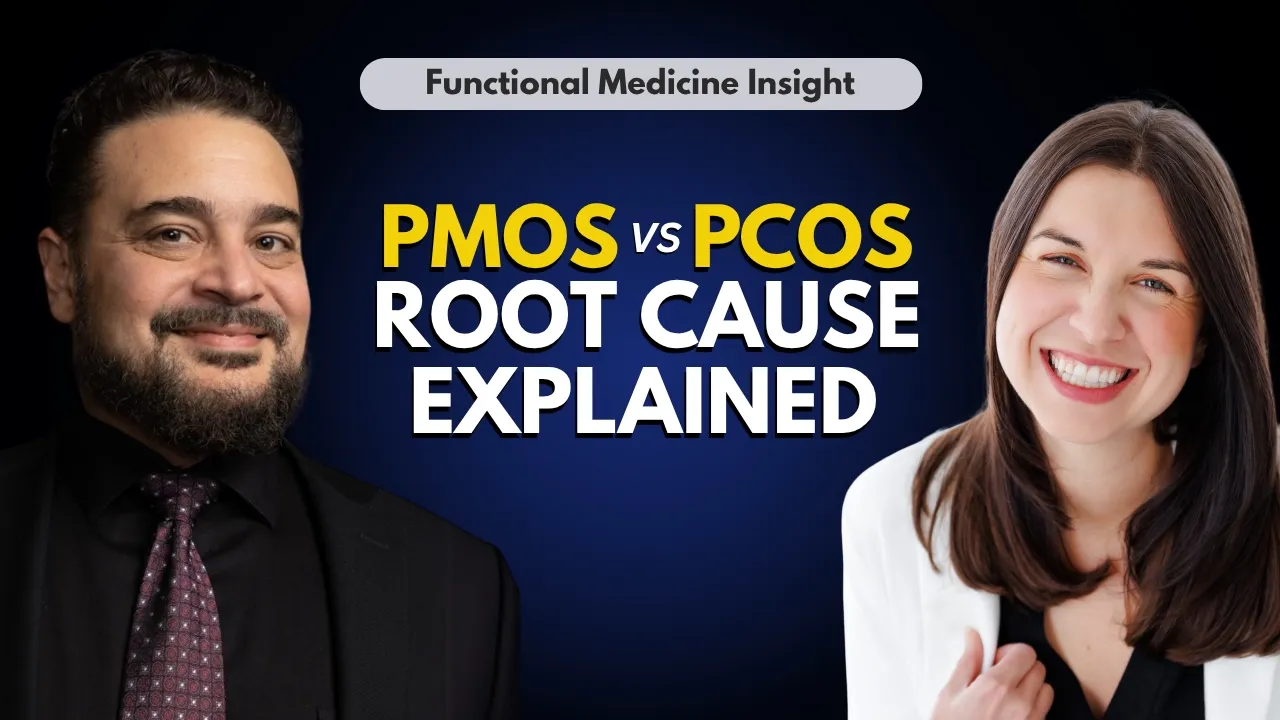
🎧 New Podcast Episode: Understanding PMOS: A Functional Medicine Approach to PCOS
How to watch/listen: Log into your account, select the Bronze Mastermind, and scroll down to the "Expert Interviews, Insights & Podcasts" section to find the episode.
Check Out This Month's Blog Post
PCOS Was Renamed PMOS: What Practitioners Need to Know
This month’s blog explores the recent shift from PCOS to PMOS, and why this name change matters clinically.
The article also discusses how the Rotterdam criteria still inform diagnosis, why ovarian imaging is only one part of the picture, and how a functional medicine lens can help practitioners look beyond symptom suppression to better understand the physiology driving the condition.
Click here to view the article!
Help Us Grow Our Community!
Know a colleague who would benefit from being part of this Mastermind? Feel free to invite them to join us!
Thank you for being part of our community!
-The FMP Essentials Team


Responses