
PCOS Was Renamed PMOS: What Practitioners Need to Know
Jun 19, 2026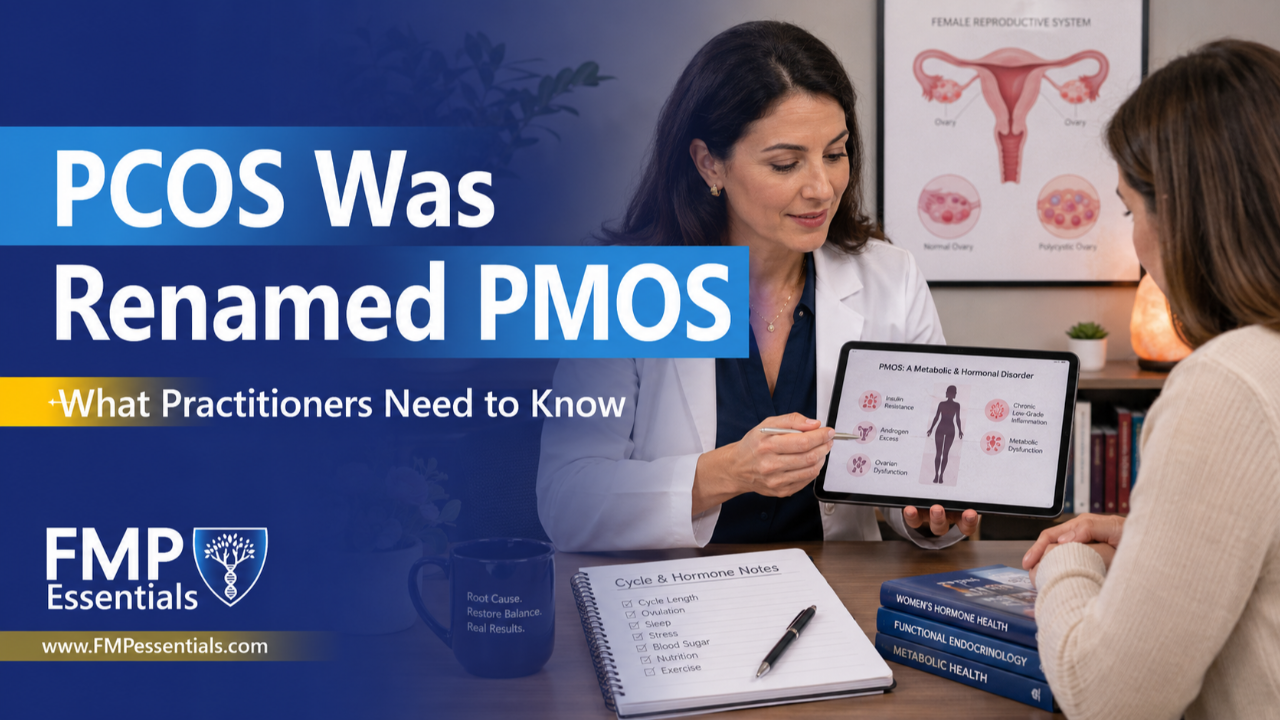
Polycystic ovary syndrome (PCOS) has officially been renamed polyendocrine metabolic ovarian syndrome (PMOS).
For practitioners, this is more than a terminology update. It reflects a clinical reality that functional medicine practitioners have long recognized: this condition is not simply about ovarian cysts.
In this month’s early release episode of the FMP Essentials Show, Dr. Yousef Elyaman and Dr. Melody Hartzler discuss why the new name matters and how it may help clinicians better understand the physiology behind this common condition.
Why the Name Changed
The old name, polycystic ovary syndrome, placed the focus on the ovaries and implied that ovarian cysts were central to the diagnosis. But many patients with this condition do not have ovarian cysts, and the “cysts” described are often immature follicles rather than true cysts.
As Dr. Hartzler explains in the episode, the prior name did not clearly communicate what was happening physiologically. It highlighted one possible feature while obscuring the broader endocrine, metabolic, reproductive, dermatologic, and psychological patterns that may be involved.
That distinction matters clinically.
When the name focuses primarily on cysts and ovaries, patients may be told they do not have the condition because their ultrasound looks normal. Practitioners may also be more likely to focus on suppressing symptoms rather than asking what is driving the ovarian response in the first place.
PMOS Reflects a Multi-System Condition
The new name, polyendocrine metabolic ovarian syndrome, better reflects the fact that this condition involves multiple systems.
Patients may present with irregular or extended cycles, heavy bleeding, acne, hirsutism, androgenic hair loss, fertility challenges, mood changes, fatigue, skin tags, or signs of insulin resistance. Some patients may have obvious metabolic dysfunction, while others may be lean with normal-looking standard labs.
This is one reason the name change is so clinically relevant. It encourages practitioners to look beyond the ovary and consider the broader endocrine-metabolic terrain.
In the episode, Dr. Elyaman emphasizes that the ovary is often responding to upstream signals. In other words, the ovary may not be the root problem. It may be expressing the downstream effects of insulin resistance, inflammation, stress physiology, altered hormone signaling, or other metabolic drivers.
What This Means for Diagnosis
For clinicians, the diagnostic framework still builds on the Rotterdam criteria. In adults, diagnosis generally requires two out of three findings: ovulatory dysfunction, clinical or biochemical hyperandrogenism, and polycystic ovarian morphology on ultrasound or elevated anti-Müllerian hormone when appropriate.
This is important because ovarian morphology is only one possible criterion. A patient does not need to have ovarian cysts on ultrasound to meet diagnostic criteria if the other features are present.
The episode also highlights a common clinical challenge: patients may have symptoms such as irregular cycles, acne, hirsutism, or fertility concerns, but may have been told they do not have PCOS because their ovaries “look normal.” The shift to PMOS may help practitioners and patients better understand that the condition is broader than imaging findings alone.
In adolescents, practitioners should be especially cautious with over-reliance on ultrasound. Current guidance emphasizes ovulatory dysfunction and hyperandrogenism as more relevant diagnostic features in this population, while recognizing that cycle maturation takes time after menarche.
Moving Beyond Symptom Suppression
Conventional management often includes oral contraceptives, metformin, spironolactone, or newer metabolic medications depending on the patient’s goals and presentation. These tools may be appropriate in some cases, but Dr. Elyaman and Dr. Hartzler also highlight the importance of asking a deeper question:
What is driving the pattern?
For practitioners, PMOS invites a broader assessment of insulin signaling, androgen expression, ovulatory function, thyroid status, inflammation, liver health, stress physiology, sleep, body composition, and cardiometabolic risk.
This does not mean every patient needs every test. It means the clinical lens should match the complexity of the condition.
Why the Name Change Matters for Patient Care
Names shape how clinicians think. They also shape how patients understand their bodies.
When patients hear “polycystic ovary syndrome,” they may assume the condition is only relevant if they have ovarian cysts or are trying to conceive. PMOS creates space for a more accurate conversation: this is a systemic endocrine-metabolic condition that may affect cycles, skin, fertility, metabolism, inflammation, and long-term health.
That shift can also reduce fragmentation. Instead of treating acne, irregular cycles, weight changes, and fertility concerns as disconnected issues, practitioners can begin to see them as potential expressions of the same underlying physiology.
Clinical Takeaway
The transition from PCOS to PMOS is not just a new label. It is an opportunity to update the clinical conversation.
For functional medicine practitioners, the key question is not simply, “Are there cysts on the ovaries?” It is, “What is influencing the endocrine and metabolic signals that are changing ovarian function?”
By using a multi-system lens, practitioners can better identify the drivers of symptoms, educate patients more clearly, and build care plans that address the physiology beneath the diagnosis.
References
- Teede HJ, et al. Polyendocrine metabolic ovarian syndrome, the new name for polycystic ovary syndrome. The Lancet. 2026.
- Endocrine Society. Polyendocrine Metabolic Ovarian Syndrome: New name to improve diagnosis and care of condition affecting 170 million women worldwide. Published May 12, 2026.
- American Society for Reproductive Medicine. PCOS is Now PMOS: Understanding the Name Change. Published May 27, 2026.
- Teede HJ, Tay CT, Laven JJE, et al. Recommendations from the 2023 International Evidence-Based Guideline for the Assessment and Management of Polycystic Ovary Syndrome. J Clin Endocrinol Metab. 2023;108(10):2447-2469.
- FMP Essentials Show. Early release episode transcript: Dr. Yousef Elyaman and Dr. Melody Hartzler on PMOS.
About the FMP Essentials Mastermind
Cases like this one are what we work through in the FMP Essentials Mastermind, a functional medicine mentorship community for licensed clinicians. Each month brings a live clinical deep dive, real case review, and access to Dr. Yousef Elyaman and a network of practicing physicians, NPs, and PAs. Explore the Mastermind.
Author

